
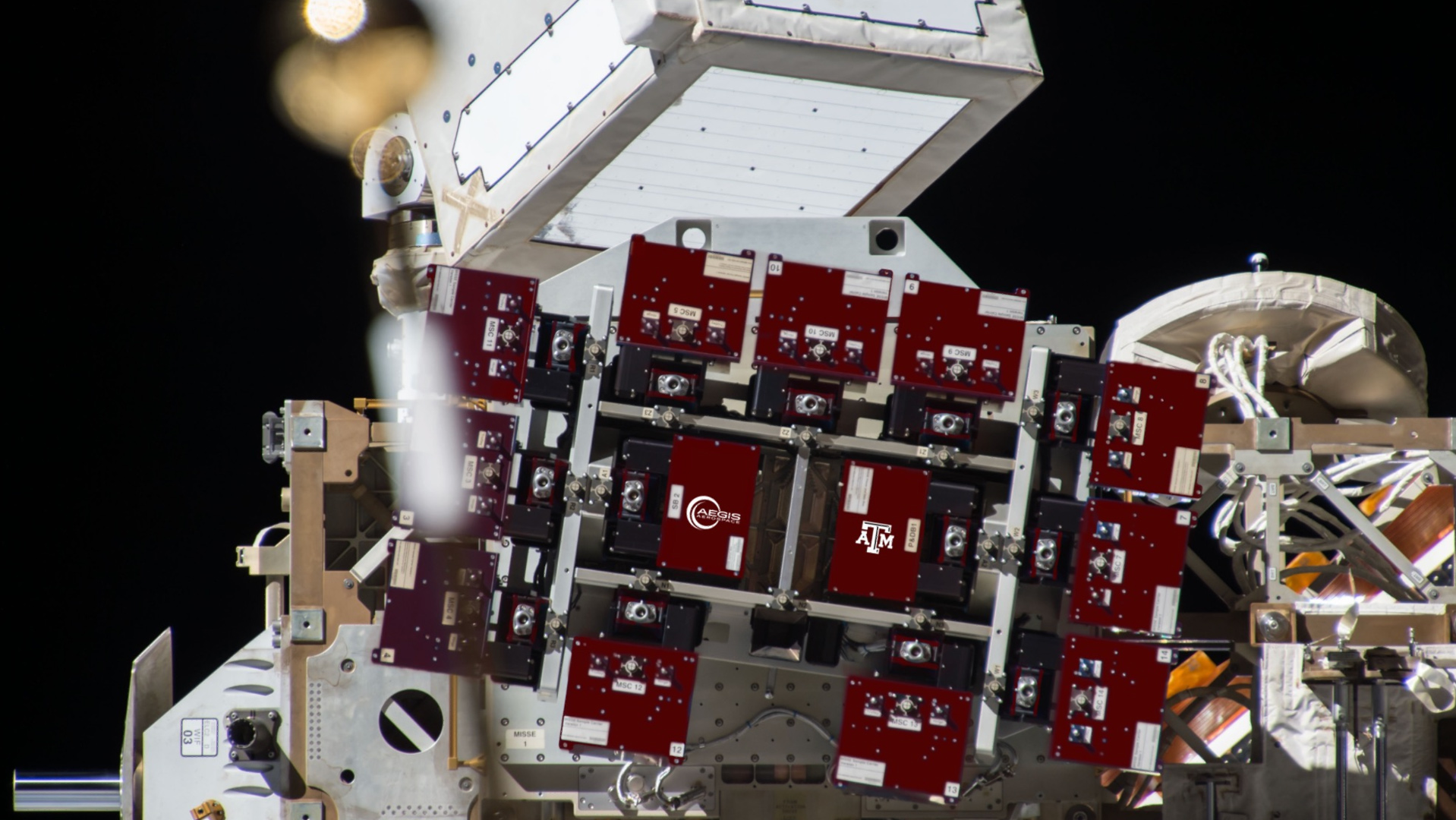
The call for TAMU-SPIRIT-2 experiments closed on September 21, 2026. A future Call for Experiment Proposals is expected in Spring 2027 on this website.
-
TS1-01
Shape Memory Alloy Torque Tube-Based Morphing Radiator
The experiment will advance the technology readiness level (TRL) of a radiator design utilizing a shape memory alloy torque tube as an actuator to expose an emissive surface. The acquisition of on-orbit data will allow researchers to better model the system’s TRL in a space setting.
PI: Dr. Darren Hartl, Department of Aerospace Engineering
Co-PI: Thomas Cognata, NASA’s Johnson Space CenterTS1-02
Solar-Induced Hot Electron Current Measurements via Quantum Dot Upconversion
Researchers will study microcrystal energy production capabilities using a university researched and fabricated microcrystal doped with manganese ions to induce high-energy, electron ionization energy transfers. The sun will serve as an incident source to study the quadric relationship between current density and light intensity.
PI: Dr. Dong Hee Son, Department of Chemistry
Co-PI: Ian Murray, Department of ChemistryTS1-03
In-Orbit Thermal Insulation of Printed Aerogels and Microgravity Printability of Magnetic-Responsive Resins
Researchers will be conducting two experiments. The first being the characterization the thermal insulation of printed polymer-based aerogel panels. The second being the evaluation of magnetically responsive resins for on-orbit 3-D printing to study the effectiveness of magnetically immobilizing resins in a microgravity environment.
PI: Dr. Emily Pentzer, Department of Chemistry
Co-PIs: Dr. Peiran Wei, Texas A&M Engineering Experiment Station; Dr. Jung-Bin Ahn, Texas A&M Engineering Experiment StationTS1-04
Grape Seeds in Space
This material exposure experiment for three species of grape seeds will evaluate the effect of radiation on the viability of the seeds. The seeds will be exposed to varying radiation types then germinated on Earth to produce grapes for nutritional quality analysis.
PI: Dr. Justin Sheiner, Department of Horticulture SciencesTS1-05
Dexterous Robotics Avionics and Component Testing and Validation
The experiment will perform tasks to gather key knowledge about the performance, lifetime, and fidelity of actuator components, associated motor controller electronics and control software in a space environment. This work will de-risk the development and delivery of space-rated robotic manipulators in an ongoing collaboration between Texas A&M’s Robotics and Automation Design Lab and a commercial space station provider.
PI: Dr. Robert Ambrose, Texas A&M Engineering Experiment StationTS1-06
Chitosan in Space: Assessing Biopolymer Durability Under Vacuum and Radiation
The experiment will evaluate the durability and environmental stability of chitosan-based, insect- or shrimp-derived biopolymers and chitosan-regolith “biolith” composites during prolonged exposure to low-Earth orbit conditions. Chitosan, derived from deacetylating chitin collected from the exoskeletons of organisms such as black soldier flies and shrimp, offers a renewable and sustainable resource that integrates agricultural waste streams into closed-loop life-support systems.
PI: Dr. Justin W. Wilkerson, Department of Mechanical Engineering
Co-PI: Dr. Jeffery K. Tomberlin, Department of EntomologyTS1-07
Aggie Space Cell Initiative: Engineering Demonstration and Microbial Survivability (ASCEND)
This experiment is the first of a proposed biological research campaign to advance the biomedical understanding of radiation-induced vascular injury. For the first mission, desiccation-tolerant microbial spores (e.g., Bacillus subtilis or Deinococcus radiodurans) will be measured for metabolic recovery, fluorescence-based viability and correlation of linear energy transfer/dose histograms — resulting in a robust experiment design to be reused for future ASCEND experiments.
PI: Dr. Jeffery C. Chancellor, Director of Aerospace Medicine in the College of Medicine
Co-PIs: Dr. Serena M. Auñón-Chancellor, College of Medicine; Dr. John Ford, Department of Nuclear Engineering; Dr. Walter Cromer, Aerospace Medicine in the College of Medicine; Dr. Travis R. Hein, Department of Medical Physiology; Dr. Mariappan Muthuchamy, Department of Medical PhysiologyTS1-08
Shield-2
As a follow-up to an experiment that flew on MISSE-22, this endeavor will advance “smart skin” technologies for robotic systems in extreme environments by focusing on radiation shielding and post-flight mechanical performance of custom silicone elastomers and demonstrating a novel nanoscale radiation dosimeter based on fluorinated carbon nanotube thin films.
PI: Dr. Kalyan Raj Kota, Texas A&M Engineering Experiment Station
Co-PIs: Dr. Robert Kelley Bradley, Lamar University; Dr. Merlyn Pulikkathara, Prairie View A&M University; Dr. Masoumeh Ozmaeian, MatterMind Analytics LLC; Justin Carter, Texas A&M Engineering Experiment StationTS1-09
Radiation Sensor Suite
This experiment will demonstrate space-radiation sensing and characterization in a compact and mass-efficient package whose resultant data can inform real-time decision making and long-term design choices for managing the radiation environment surrounding our planet and others. It will do this by using two sensors for real-time monitoring of the high-energy radiation field in Low Earth Orbit (LEO) outside of the ISS.
PI: Dr. Jeffery C. Chancellor, Director of Aerospace Medicine in the College of Medicine
Co-PIs:Nick Stoffle, Axiom Space

The Texas A&M/Aegis Aerospace Multi-Use Space Platform Integrating Research & Innovative Technology (TAMU-SPIRIT) is a first-of-its-kind Texas A&M branded low-Earth orbit research platform to be flown aboard the International Space Station (ISS). It is a unique resource that can accommodate a wide range of experiments and samples for Texas A&M System faculty, researchers and students.
The facility, a partnership between Texas A&M University and Aegis Aerospace, will provide experiment space on Express Logistics Carrier 3 on the ISS for activities such as in-space research, testing, advanced materials manufacturing, robotics testing, space surveillance and tracking technologies. Texas A&M System researchers, faculty and students will have exclusive priority rights to send science, engineering and technology experiments to be installed on the TAMU-SPIRIT Flight Facility.
For more information about TAMU-SPIRIT capabilities that will help you to start planning your TAMU-SPIRIT flight experiment, check the Resource links below or contact TAMU-SPIRIT@tamu.edu.
General Timeline

*Dates subject to change
- October 21, 2026 - TAMU-SPIRIT-2 Experiment Selection Announcement
- November 4, 2026 - TAMU-SPIRIT-2 Experiment Kickoff Meeting
- Spring 2027 - TAMU-SPIRIT-3 Call for Experiment Proposals
- Summer 2027 - TAMU-SPIRIT-3 Experiment Selection Announcement
- August 2027 - TAMU-SPIRIT Flight Facility and TAMU-SPIRIT-1 Experiment Launch
- August 2027 - TAMU-SPIRIT-2 Experient Delivery
- NET January 2028 - TAMU-SPIRIT-2 Experiment Launch and TAMU-SPIRIT-1 Experiments returned
Resources
-
Q: How many experiments will be flown on TAMU-SPIRIT-2?
A: TAMU-SPIRIT-2 will carry four (4) Pallet Carriers (PCs) or Science Carriers (SCs). Each SC or PC can accommodate multiple experiments with the individual experiments selected, in part, to maximize SC and PC capabilities.
Q: Are there standard components/services that are provided by Aegis, such as cameras to have a visual on the pallet carrier?A: TAMU-SPIRIT offers measurements of temperature and UV exposure throughout a mission as well as total ionizing radiation doses, total atomic oxygen (AO) exposure, and contamination exposure services per carrier upon request. On SC’s, four cameras are mounted on a trolley that can capture photos of the SC's deck. There are no cameras on the PC. Due to the orientation of TAMU SPIRIT, we are unable to use the ISS's camera to view SC’s/PC’s.
Q: Do applicants need to submit a pre-proposal (or Letter of Intent) with the general idea of the proposal, or a short one to two page proposal, before submitting the final Notice of Intent?A: You can certainly include a project concept in your notice of intent, and we can provide some feedback to you, upon request. The scope of experiments that can be flown on TAMU SPIRIT is quite expansive, so many project concepts are feasible.
Q: Are undergraduate students at Texas A&M permitted to serve as a PI or co-PI on a proposal, or must they be formally sponsored by a faculty member?A: The PI and Investigator team qualifications and history are a factor in the technical merit score of the proposal, and the knowledge and history of the PI to their experiment is critical to the selection of proposals. Student proposals must have a faculty PI and the students are welcome to be Co-Is if their experience and knowledge base is applicable to the experiment.
Q: Can we form a TAMU-SPIRIT proposal team with foreign universities? The experiment is built with Texas A&M, with design inputs from students/faculty from the Indian Institute of Technology. Data is analyzed and published jointly.
A: Yes, proposals may include universities outside the Texas A&M System and international universities. The PI of the proposal must be a Texas A&M System researcher or faculty member.
Q: How are the contents of proposal documents shared within TAMU and/or beyond (whether selected or rejected)?
A: Once received through FileX, the files are transferred to a University-controlled shared Google Drive folder which can only be accessed by direct TAMU-SPIRIT managers and evaluators. The TAMU Google Drive is capable of handling information up to University Confidential (NOT Critical) Information. A description of University Confidential information can be found in the first link below. In the second link, it is highlighted how Google Drive policies make it improper to store any Export Controlled information (EAR, ITAR) or Personally Identifiable Information (PII).
Anything up to, not including, Export Controlled/PII information can be handled in proposals. We ask that you do not include this information in your proposal. Confidential and sensitive information below those categories can be handled as part of a proposal.
DC-1 Data Classification Policy & Procedures | IT Security & Risk Documentation [https://docs.security.tamu.edu/docs/security-controls/DC/DC-1]Google Drive - HIPAA, FERPA, and Other Sensitive Data Storage [https://service.tamu.edu/TDClient/36/Portal/KB/PrintArticle?ID=559]Q: Is there any maximum/minimum number associated with a project's budget? My understanding is PIs cannot ask for any funding, and all costs associated with the ground research will be on the PI.A: The responsibility to provide funding for the development costs of the experiment lies entirely upon the PI and experiment team (point five in the Proposal Narrative section of the Call for Proposals). Given that these development costs are outside of the services TAMU-SPIRIT provides, there is no maximum or minimum experiment cost. Note that proposals will be evaluated on their Technical Merit, which includes risk associated with experiment funding as stated in the Proposal Evaluation Plan.
Q: Maintaining atmosphere-like conditions would be preferable for our experiment, rather than direct vacuum exposure. Would it be possible to design an airtight, sealed chamber that contains the experiment, with the interior maintained at atmospheric pressure, while operating on the TAMU-SPIRIT platform aboard the ISS?A: This is possible, but would add some complexity to the experiment, which should be addressed in the project proposal. TAMU-SPIRIT experiments will be unattended during their duration on orbit, except for systems that can be controlled via switches (heaters, etc.), and would be unpowered for periods of time during installation and de-installation. An experiment could be integrated into an atmospheric “bottle”, but that container would require additional design considerations and greater involvement of the NASA Safety Review Board during development.
Q: What kind of testing will the experiment need to undergo before they are qualified for launch?A: Standard testing, performed by Aegis Aerospace, prior to launch of integrated carriers includes a carrier level bakeout thermal vacuum test for all passive experiments and a vibration test for all experiments. It is encouraged for experiments that have additional concerns with the thermal, radiation, vacuum, and/or vibratory environment during transport or operation on the ISS to plan their own testing campaign to ensure compliance with NASA Safety Standards and increase confidence in the experiment design. TAMU-SPIRIT can assist in identifying where to acquire these services, upon request.
Q: Beyond the selection date, what does an outline of the expected timeline for our sample delivery to TAMU-SPIRIT look like?A: For experiments chosen for TAMU-SPIRT-2, the completed experiments are to be delivered to Aegis Aerospace in Houston around August of 2027. Aegis will complete all integration of the experiments into the pallet carriers, complete thermal and vibration testing, and conduct all safety reviews with NASA prior to launch. Aegis Aerospace will offer biweekly tag-ups to selected experiments to assist in their technical development after the initial Kickoff Meeting. The integrated PC’s and SC’s will be delivered to the cargo launch provider ~late March 2028 for a launch a few weeks later. Cargo launch dates that far out are not yet scheduled, so this date may move. If the launch occurs in early April 2028, carriers will be processed by the ISS and transported to the robotics team through an airlock. Individual experiments will then be integrated in to the facility and be powered on and checked out. This process could take anywhere from a few days to a few weeks. Nominally, experiments should be ready for operation a few weeks after launch - using the planning dates above, this could be late April 2028. Experiments are nominally operated for 6 months, although PIs can request longer (12-month) operational periods. Aegis Aerospace will operate the experiments in cooperation with the PIs, and will coordinate upload commands and download data with the PI. The experiments will be de-integrated from TAMU-SPIRIT and returned to Earth on subsequent cargo spacecraft, Aegis Aerospace will process the returned Carriers and then return the experiments to the PIs.