

How do you advance your work in a university research lab to the point where businesses or government agencies recognize its commercial potential in the marketplace?
The solution requires entrepreneurial skills and training gained through our real-world, hands-on, immersive National Science Foundation Innovation Corps (NSF I-Corps) program.
The NSF I-Corps program curriculum is based on the Lean Startup framework, where faculty, researchers and students across the The Texas A&M University System learn the market potential of an innovation and are trained to incorporate innovations developed in research labs into commercially viable companies to solve societal problems.
Since 2012 Texas A&M University has been an I-Corps node and Site. The university has been a founding member of the NSF I-Corps Hub: Southwest, a member of the National Innovation Network since 2023.
Transform your research into market-ready technology. The program roadmap shows how Texas A&M System researchers turn early-stage projects and invention disclosures into real-world commercial outcomes through the four-week virtual NSF I-Corps IdeaLaunch program. Throughout the program, you will master customer discovery techniques to identify target markets, strengthen translational grant proposals (such as NIH, DOE, or NSF-TTP) and gain official NSF Lineage, qualifying your team to apply for the National I-Corps Teams program and its $50,000 grant. Whether your goal is internal R&D growth, licensing, or launching an SBIR/STTR-funded startup, our TAMU I-Corps team is here to guide your path.
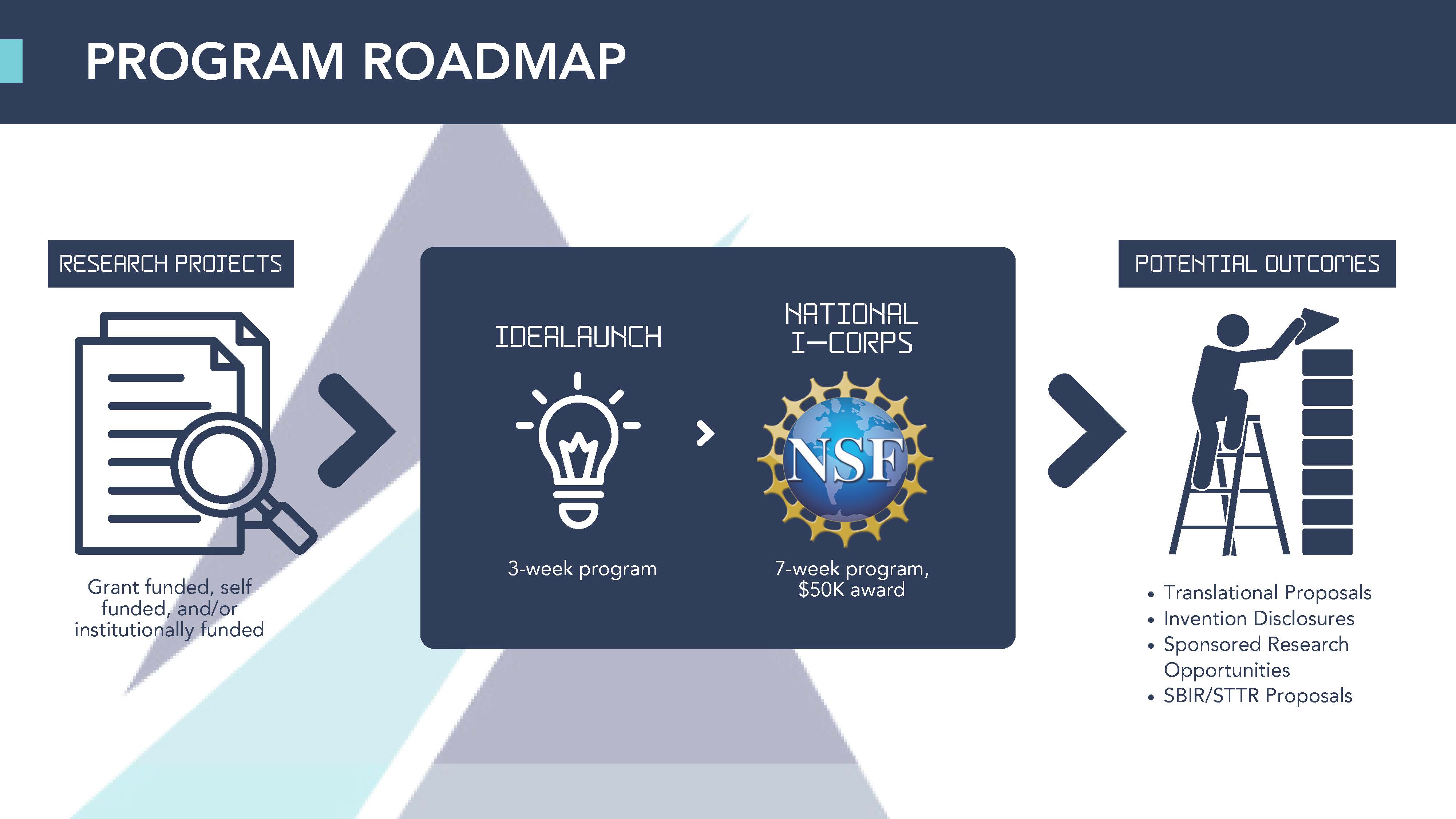
The program begins with your team’s grant-funded, self-funded, or institutionally funded research project. From there, you move through two steps.
The first step moves your project through the three-week IdeaLaunch program, which will teach you:
IdeaLaunch is a learn-by-doing startup bootcamp for doers and thinkers open to all entrepreneurial minds - researchers, engineers, scientists and business or creative minds - who are ready to solve problems and turn their ideas into potential businesses.
The program is oriented to simulate the time- and cash-constrained environments startups operate in. Instructors will push, challenge and question your business idea to provide direct, open and constructive feedback. Teams will conduct customer discovery interviews to gain real world insight into their customer bases and learn to adjust their proposed business models based on market needs.
Team Requirements
Team Expectations
This second step is a seven-week intensive customer discovery program, NSF I-Corps, that will better prepare you to:
This program is an immersive, entrepreneurial training experience that assists the process of moving from invention to impact. Seasoned entrepreneurs train and prepare scientists and engineers to extend their focus beyond the university laboratory — accelerating the economic and societal benefits of NSF-funded and other basic research projects ready to move toward commercialization.
Throughout this assumption, hypothesis-testing and customer-focused discovery process, you learn to create a business strategy and gather important insights to maximize the impact of your innovation.
Questions? Contact Us.
The NSF I-Corps program at Texas A&M is geared towards developing the innovation and entrepreneurial spirit in our students and faculty, with the latter serving as principal investigators to develop this skillset. This program helped us figure out what the minimum viable product was that so that it would be more effective and more adaptable in the marketplace.
This learn-by-doing process for student doers and thinkers is designed to help explore the commercial viability of your research and technology.
Requirements
You will conduct customer discovery interviews to gain real-world insight into customer bases and learn to adjust proposed business models based on market needs. Following the successful completion of ImpactLaunch, you will receive a certificate of completion from the NSF I-Corps Southwest Hub.
Contact for more information:
